

How OpenText Documentum Extends the Digital Thread Beyond PLM
/For many manufacturers, PLM is the authoritative source for released product design and development information. But while PLM may hold the truth, it is rarely the only place that truth needs to be used.
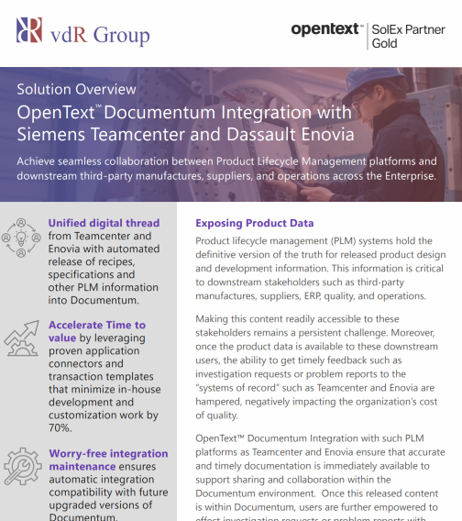
Manufacturing, supply chain, quality, maintenance, training, and support teams all rely on released product information to do their jobs effectively. The challenge is that these stakeholders often need access to that information outside the PLM environment, and in a context that aligns with the way they work. This accompanying solution overview frames this clearly: PLM contains the definitive version of the truth for released product information, but making that information readily accessible to downstream stakeholders remains a persistent challenge.
This is where OpenText Documentum can play a meaningful role.
By integrating Documentum with PLM platforms such as Siemens Teamcenter and Dassault Enovia, organizations can extend the reach of released product information into a governed enterprise content environment that is better suited for broad access, collaboration, and downstream operational use.
PLM is the system of record. Documentum helps operationalize access.
In many organizations, the issue is not whether product information exists. It is whether the right people can access it in the right way.
Engineering teams may be comfortable working directly in PLM, but downstream users often need released information surfaced in an environment that supports their discipline-specific processes. The solution overview describes this as exposing product data to downstream stakeholders such as third-party manufacturers, suppliers, ERP, quality, and operations.
That is an important distinction.
This is not about replacing PLM. It is about extending the value of released PLM information across the enterprise through Documentum, where it can be more effectively consumed, governed, and acted on by non-engineering stakeholders.
Turning the digital thread into something practical
The phrase “digital thread” can sometimes sound abstract. In practice, its value comes from connecting systems and stakeholders without losing context, control, or traceability.
The PDF describes a unified digital thread in which recipes, specifications, and other PLM information are automatically released into Documentum. It also describes Documentum for PLM as an end-to-end digital backbone for sharing application data in context among enterprise systems on demand.
That concept becomes especially tangible in the page 2 diagram, which shows PLM-centric information such as recipes, operations data, drawings, work instructions, and quality documentation being made available to ECM-centric stakeholders across purchasing, supply chain, third-party manufacturing, inspection, quality, manufacturing, maintenance, and support.
That is what a practical digital thread looks like: released product information flowing into the parts of the business that need it most.
The real opportunity is closed-loop collaboration
One of the strongest aspects of this model is that it is not simply a downstream publishing mechanism.
Too often, manufacturers focus on getting released information out of PLM, but not on how downstream teams can contribute meaningful feedback back into the system of record. That gap slows response times, increases manual work, and can raise the cost of quality.
According to the solution overview, once released content is available in Documentum, users can create investigation requests or problem reports using redline and markup tools, and that feedback can be automatically sent back to PLM to inform product design teams.
Page 2 reinforces that point by describing bidirectional use cases in which post-design product issues can be submitted from Documentum back into Teamcenter or Enovia through problem reports or investigation requests. Those inputs can then inform native PLM processes such as engineering change requests and quality documentation.
This is where the integration becomes especially valuable. It does not just improve visibility. It supports a closed-loop digital thread.
Why this matters for manufacturers
When downstream teams struggle to access released product information in context, the consequences are real. Suppliers may wait on documentation. Manufacturing teams may lack full product context. Quality teams may struggle to link issues back to engineering records. And support teams may not have fast access to released information when it matters.
The solution overview ties these challenges directly to business outcomes, noting that manual intervention and disconnected feedback loops can contribute to costly redesigns, scrap, and rework.
An integrated PLM-ECM approach helps address those issues by making released product information more accessible to downstream users while preserving the governance and traceability required in complex manufacturing environments.
Faster time to value matters too
Another important point in the attached overview is speed and sustainability of implementation.
Rather than depending entirely on custom integration work, the solution emphasizes proven application connectors and transaction templates that can reduce in-house development and customization effort by 70 percent.
It also highlights worry-free integration maintenance, including automatic compatibility with future upgraded versions of Documentum and supported PLM platforms.
For manufacturers, that matters. The best integration strategy is not just one that works at launch. It is one that continues to deliver value without creating a long-term maintenance burden.
Final thoughts
PLM will continue to serve as the system of record for product design and release. But the broader enterprise still needs that information to move, safely and intelligently, into the environments where downstream work gets done.
By integrating OpenText Documentum with PLM platforms like Teamcenter and Enovia, manufacturers can extend released product information into a more accessible and collaborative enterprise content environment while also creating a structured path for downstream feedback to flow back into PLM.
That is how the digital thread becomes more than a concept. It becomes operational.