

Introducing OpenText Hub for Bluebeam Collaboration
/vdR Group is introducing OpenText Hub for Bluebeam Collaboration, a new offering that connects OpenText Content Management and OpenText Documentum with Bluebeam Studio. It pairs OpenText's enterprise document governance with Bluebeam's best-in-class markup, so design reviews move faster without the drawings ever leaving control. We'll be showing it live at OpenText World.
Review happens outside the system of record

EPC firms and owner-operators such as utilities and manufacturers depend on controlled drawings to execute projects, manage assets, and stay compliant. Bluebeam Studio has become a standard for PDF markup, redlining, and collaborative design review. The drawings themselves, however, are governed in OpenText.
Connecting the two is manual work today. Someone downloads the PDF, uploads it to a Studio Session, invites reviewers, chases status, and files the results back. Each step creates uncontrolled copies, and markups that never make it back leave the record incomplete. That gap tends to surface at the worst moments: engineering change orders, management of change, and audits.
A review, start to finish
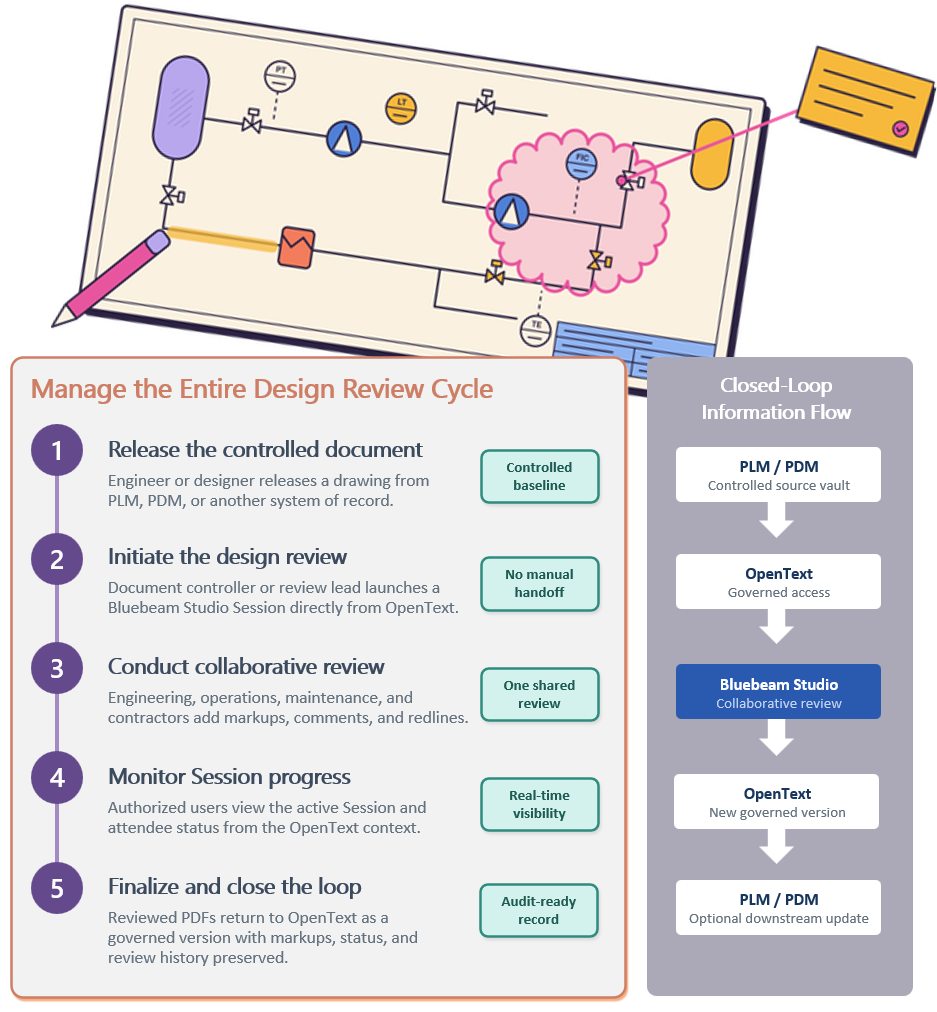
Built on Bluebeam's Sessions Roundtrip workflow, OpenText Hub for Bluebeam Collaboration automates every hand-off in an Issued for Review cycle or a management-of-change redline:
Release. The design engineer releases the approved drawing from PDM or PLM, and it is governed in OpenText.
Issue for review. The document controller selects Markup in Bluebeam from OpenText. The PDF is reserved, and a Studio Session opens with the document loaded and the controller as Host.
Mark up. Invited attendees from each discipline add markups, redlines, and annotations in Bluebeam and set their status. From OpenText, anyone can open the Session or check its progress without switching tools.
Finish Session. When the review is complete, the Host finishes the Session and the marked-up PDF returns to OpenText as a new version linked to the original, checked in with its status set to Finished.
Close the thread. Optionally, the updated PDF is registered back to PDM or PLM, keeping design and as-built records aligned.
OpenText stays the system of record. Bluebeam stays the place where teams collaborate.
Studio Sessions expire. Your record shouldn't.
Studio Sessions are built for real-time collaboration, not long-term retention. Finished Sessions are deleted from the Studio server, and inactive Sessions are archived. Without an integration, the markups that capture critical engineering decisions can simply disappear.
The Hub makes sure every markup, redline, and annotation lands in OpenText first, linked to the original drawing. The result is a governed review process: no uncontrolled copies, no Sessions left in limbo, and an audit-ready record for ECOs, management of change, and compliance.
Built for EPC firms and owner-operators
OpenText Hub for Bluebeam Collaboration is part of OpenText Hub for Manufacturing and Engineering, vdR Group's solution for connecting product and engineering data across the enterprise. It is designed for organizations that manage controlled drawings over long asset lifecycles: EPC firms delivering capital projects, and owner-operators in energy, utilities, manufacturing, and the public sector.
As an OpenText SolEx partner and a Bluebeam Development Partner, vdR Group built the integration to fit how both platforms are used in the field.
See it at OpenText World. Stop by to watch a live review cycle, from Issued for Review to Finish Session, or contact us at info@vdr.com to schedule a demo.
Powered by vdR Nexus: OpenText Hub for Engineering and Manufacturing